Comprehensive Peacebuilding Case Study, Best-Practice Framework & Global Replication Best Practicess Case The Greatest Peace Rally in Embu – 18 July 2025
On 18 July 2025, the international GPPBNet team, the Africa GPBNet team, and the Kenya GPBNet teams came together in Embu for the best peace rally of its kind.
Get Your International Certification https://1gpb.net/did-you-get-international-accreditation
Governors, political leaders, religious leaders, Gen Z leaders, and youth leaders united under the GPBNet banner. They spoke, discussed, and prayed together in a historic event that stopped the “Z revolution” in Kenya, across Africa, and worldwide in 2025 watch Embu Rally Video https://www.youtube.com/watch?v=kVqAl0E5QdA
(Note: The Z revolution began in Kenya in 2024 and quickly spread across Africa and the rest of the world.)
GPBNet’s Core Approach
GPBNet provides practical instruments that create real model peace communities. These tools are rooted in the “True Love Revolution.” They bring together all local stakeholders — leaders and ordinary citizens alike — to work daily with the population.
The goal is to build mutual-prosperity communities on the ground. By doing this consistently in every community, GPBNet empower to complete the foundation of ultimate global peace this year — both locally and worldwide.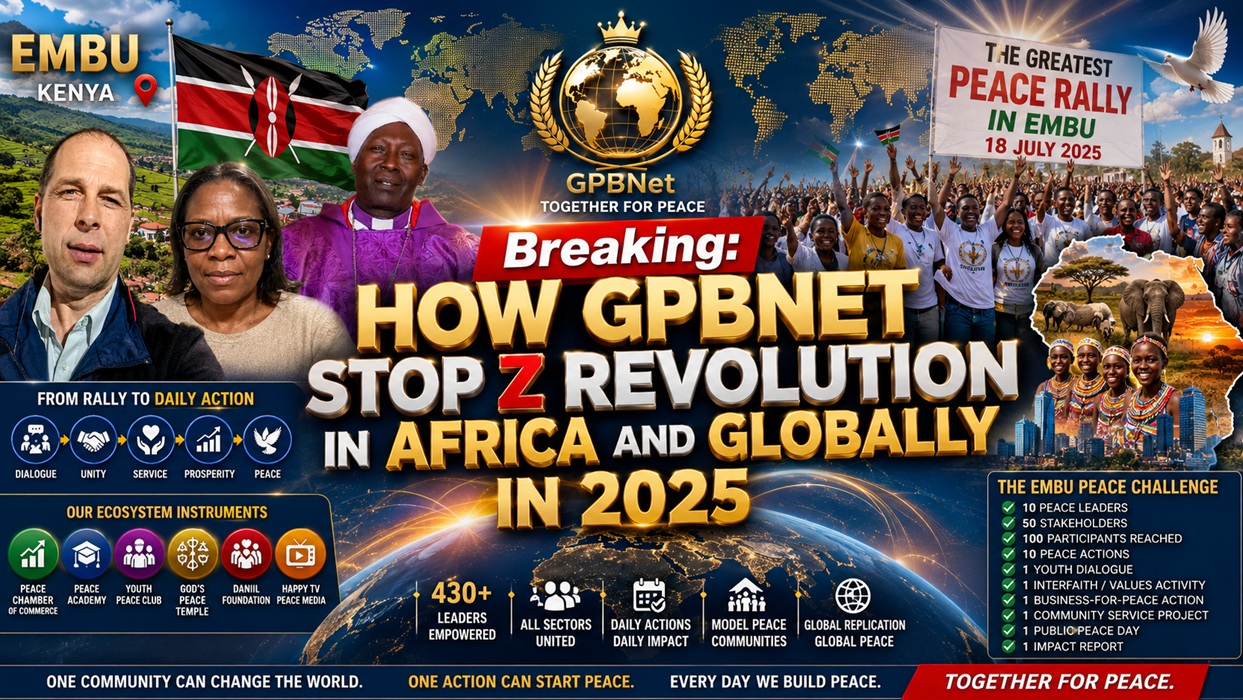
Call to Action
This research case includes a clear invitation:
Everyone — from ordinary citizens to presidents — is called to join GPBNet.
Participants can:
Receive their own International Certification
Take part in certification trainings
Attend GPBNet summits
Carry out daily peace actions and rallies
These steps help build model peace communities both online and in the field, creating lasting local and global impact.
In short:
GPBNet’s method is simple and practical — unite leaders and people, apply True Love instruments every day, create mutual prosperity at the community level, and scale that model until global peace becomes the lived reality in 2025.
This package consolidates the supplied GPBNet source material and the external Kenya context research into one detailed case study and implementation manual. It treats the 18 July 2025 Embu Peace Rally as a proposed prototype for moving from a public peace event to a continuing community peacebuilding ecosystem.
1. EXECUTIVE SUMMARY
--------------------
The Embu case is valuable because the core idea is not simply to organize a rally. The proposed model is to use a rally as a gateway into sustained dialogue, volunteer organization, leadership development, community service, economic cooperation, media storytelling, measurement and replication.
The GPBNet source describes the Embu initiative as a meeting point for international, African and Kenyan GPBNet teams and a broad coalition of leaders, clergy, educators, press, charities, businesses, youth, families and organizations. The stated objective is to move from public unity to daily peacebuilding and ultimately to Model Peace Communities.
External context research shows why Embu was a relevant setting: Kenya experienced significant youth-led protest activity in 2024 and renewed unrest in 2025. Embu was among counties affected by the 7 July 2025 Saba Saba demonstrations, and local unrest continued on 8 July. Kenya's National Cohesion and Integration Commission called for intergenerational dialogue and safe spaces for engagement shortly afterward.
The strongest replicable lesson is: Rally → Dialogue → Organization → Daily Action → Measurement → Model Community → Replication.
2. CASE STUDY SCOPE & EVIDENCE METHOD
-------------------------------------
Primary source basis: the supplied GPBNet case-study material, including the Embu rally brief, Nicolae Cirpala speech text, GPBNet program descriptions, accreditation pathway, ecosystem descriptions, campaign material and supplied leader-recognition lists.
External context: Kenyan institutional and media reporting on the July 2025 protests and dialogue environment, including KNCHR, Amnesty Kenya, NCIC, Reuters/AP/DW and Kenyan local reporting.
Evidence categories used throughout this package: (A) externally reported fact; (B) GPBNet-reported; (D) proposed best practice or implementation recommendation.
This distinction is deliberate. A professional peacebuilding case study becomes more credible when it clearly separates documented events from organizational claims and from future targets.
3. EMBU CONTEXT: WHY THE LOCATION MATTERED
------------------------------------------
Embu was operating in a high-tension national environment. On 7 July 2025, KNCHR reported fatalities, injuries, arrests and road blockades across multiple counties, including Embu. Amnesty Kenya likewise listed Embu among counties affected by the Saba Saba protests.
On 8 July 2025, local reporting described renewed demonstrations in Embu following the arrest of Manyatta MP Gitonga Mukunji, with road disruption, burning tyres and police attempts to calm the situation.
The National Cohesion and Integration Commission subsequently emphasized intergenerational dialogue, peaceful democratic expression, restraint, healing and inclusive conversation. This aligns strongly with the case-study logic of creating a forum where youth, elders, institutions and community stakeholders can interact.
The lesson for replication is not that communities should suppress legitimate grievances. It is that peacebuilding should create constructive channels for grievances, accountability, dialogue, service and reform while rejecting violence and protecting civic space.
4. THE EMBU RALLY: STATED GPBNET PURPOSE
----------------------------------------
The supplied GPBNet material presents the 18 July 2025 Peace2025 Embu Rally as a turning point intended to unite people and organizations around daily peacebuilding.
The rally speech emphasizes gratitude toward leaders, governors, clergy, educators, press, charities, businesspeople, youth, families and organizers.
The speech's central operational message is: do not merely dream of peace; build it daily. The document turns this into a repeatable operating system rather than a one-day slogan.
5. CORE PEACEBUILDING PHILOSOPHY
--------------------------------
GPBNet's source language centers on unity, faith, daily peacebuilding, mutual prosperity, recognition, networking, education, humanitarian action, youth empowerment, media and community organization.
The practical interpretation is: peace becomes stronger when people repeatedly cooperate around real problems and experience tangible benefits from cooperation.
A useful working formula is: PEOPLE + PURPOSE + PARTNERSHIPS + ACTION + MEASUREMENT = PEACEBUILDING CAPACITY.
A second formula captures the transition from event to institution: CONNECT → LISTEN → UNITE → ACT → MEASURE → REPORT → IMPROVE → REPEAT.
6. STAKEHOLDER ECOSYSTEM
------------------------
The model intentionally includes multiple sectors: government and public leaders; youth and Gen Z representatives; faith communities; schools and universities; businesses; NGOs and charities; media; families; cultural groups; professional associations; and international partners.
The design principle is that peace should not be owned by a single institution. The local chapter functions as a connector and coordinator.
Every stakeholder should receive a defined role, not merely an invitation to attend. The most useful roles are dialogue, service, resources, expertise, youth participation, communications, safeguarding and measurement.
7. GPBNET ECOSYSTEM INSTRUMENTS
-------------------------------
Peace Chamber of Commerce: business, entrepreneurship, professional networks, ethical enterprise and prosperity-oriented cooperation.
Peace Academy: peace education, leadership development, schools, universities, teachers, researchers and structured training.
Youth Peace Club: youth, volunteers, internships, ecology, sports, hobbies, wellness, travel and global-village activities.
God's Peace Temple: GPBNet's interfaith/spirituality/futurology framework; participation should remain voluntary and respectful of different beliefs.
Daniil Foundation for Peace: social services, charities, health, children and families.
Happy TV / Peace Media: media, culture, arts and positive storytelling.
Peace Party / Leaders Association: the source describes a leaders' platform. For replication, any political activity should be clearly separated from nonpartisan peacebuilding to protect inclusiveness and credibility.
8. FROM PHONE TO PEACE TEAM
---------------------------
The supplied material uses a story of a volunteer beginning with a phone, fear and a desire to stop local violence, then mobilizing people and creating daily actions. This is best treated as a GPBNet-reported model story.
The transferable principle is low-barrier organizing: one committed person can begin with a phone, a local problem, ten trusted contacts and a simple weekly action.
Growth sequence: 1 organizer → 10 core volunteers → 30 active volunteers → 100 participants → sector teams → local peace council → model community → neighboring-community replication.
The key safeguard is quality control: growth in names, certificates or followers must not be confused with growth in active peacebuilding work.
9. THE 430-LEADER EMPOWERMENT
-------------------------
GPBNet empowers to mobilizing or recognizing 430+ leaders in a location. The practical recommendation is to turn this from a number into a structured leadership architecture.
Suggested allocation: 50 business; 50 education; 50 faith; 50 youth; 50 community; 50 women/family; 50 media/culture; 50 NGO/social impact; 30 professional/technical = 430.
Each recognized leader should have a defined role, code of conduct, training requirement and evidence-based action portfolio.
Recognition should follow contribution wherever possible: commitment + training + action + evidence + review.
10. PEACE AMBASSADOR ACTION SYSTEM
----------------------------------
The supplied accreditation pathway is: APPLY → GET REVIEWED → RECEIVE ACCREDITATION → TAKE ACTION → REPORT RESULTS → RENEW & ADVANCE.
For practical implementation, an ambassador should complete orientation, participate in community service, support dialogue, report activity, recruit responsibly and uphold safeguarding and nonviolence standards.
Daily: one constructive communication or peace-support action. Weekly: one direct action and one partner contact. Monthly: one dialogue/service activity and an impact report. Quarterly: one larger project and team review.
The objective is to make the title functional: a Peace Ambassador is a person with responsibilities and evidence engaged in daily peace actions.
11. YOUTH & GEN Z STRATEGY
--------------------------
Kenya's 2024–2025 protest experience demonstrates the speed and reach of youth digital mobilization. A peacebuilding model should not treat youth only as an audience or a risk group.
Give youth real G Franchises and ownership: youth council seats, digital reporting, community projects, entrepreneurship, sports, environmental work, mediation training and project leadership.
A practical rule: every local peace council should include youth in decision-making and give them at least one independently led project each month.
The message is not 'stop expressing grievances'; it is 'create safe, constructive channels and G Franchises where grievances can be heard, solutions tested and reform pursued without violence.'
12. DIALOGUE & RECONCILIATION MODEL
-----------------------------------
Start with listening before solutions. Ask: What threatens peace here? Who is affected? Who has influence? What can we change within 30 days?
Use small G circles before large rallies. A 10–30 person listening circle can identify issues and build trust more effectively than a stage-only event.
Then hold cross-sector dialogue: youth + leaders + faith + business + educators + civil society + security/community safety representatives where appropriate.
Outputs should be written commitments, named owners, dates and measurable actions.
13. DAILY PEACE ACTION MENU
---------------------------
Listening Circle; Youth–Leader Dialogue; Interfaith Service Day; Business-for-Peace initiative; community cleanup; tree planting; food or family support; mentoring; skills training; cultural exchange; sports-for-peace; digital peace storytelling.
Every action should have one problem, one owner, one target group, one date and one measurable result.
Small visible wins build trust. The purpose is to create repeated experiences of cooperation.
14. PEACE MEDIA & DIGITAL HYGIENE
---------------------------------
Every chapter can use a smartphone to document constructive activity. Recommended weekly story format: WHAT HAPPENED? WHO PARTICIPATED? WHAT PROBLEM WAS ADDRESSED? WHAT CHANGED? WHAT HAPPENS NEXT?
Digital peacebuilding should prioritize verification, context, non-dehumanizing language, privacy, consent and de-escalation.
Avoid rumors, doxxing, inflammatory accusations, partisan manipulation and sensational claims.
Use solution-based storytelling: identify the problem, show people cooperating, document evidence and invite the audience to a constructive next step.
15. BUSINESS & MUTUAL PROSPERITY
--------------------------------
Peace and prosperity can reinforce each other with G Franchises. Conflict damages commerce, employment, investment and trust; cooperation can create shared interests.
Peace Chamber activities can include networking, apprenticeships, youth entrepreneurship, ethical business, farmer-market links, technology projects and corporate sponsorship of community initiatives.
Suggested indicators: youth trained, apprenticeships, businesses participating, jobs or income opportunities created, community projects sponsored and resources mobilized.
Economic activity must remain ethical, transparent and separated from misleading promises of guaranteed wealth.
16. FAITH & SPIRITUAL DIMENSION
-------------------------------
Strong emphasis on Interfaith cooperation, Heavenly Parents, prayer, True Love, forgiveness, daily spiritual devotion and the Peace Kingdom,
For global replication, the spiritual dimension can coexist with inclusive peacebuilding when participation is voluntary and the program respects religious pluralism and freedom of conscience.
Practical faith roles: reconciliation, moral education, volunteer networks, family support, humanitarian service and interfaith dialogue.
Recommended principle: VALUES + EVIDENCE + ACTION.
17. ACCREDITATION ARCHITECTURE
------------------------------
GPBNet provide international accreditation for individuals, organizations, businesses, NGOs, schools, universities, governmental bodies, faith communities, youth organizations, media, cultural organizations, community leaders, professional associations and international institutions.
Five-level ladder: Peace Supporter; Peace Volunteer; Peace Ambassador; Community Peace Leader; Model Peace Community.
A credible accreditation system should specify eligibility, learning outcomes, practical requirements, evidence, review, renewal and complaints/safeguarding procedures.
The certificate should represent verified participation and action.
18. MEASUREMENT & EVIDENCE
--------------------------
Use an input–activity–output–outcome–impact chain. Inputs are resources; activities are actions; outputs are participation and completed projects; outcomes are changes in relationships, services or opportunities; impact is longer-term community improvement.
Minimum dashboard: peace actions; volunteers; youth engaged; organizations cooperating; dialogues; beneficiaries; businesses participating; environmental actions; conflicts mediated; volunteer hours; resources mobilized; stories produced; new leaders trained.
Collect baseline data before a major intervention whenever possible and follow up at 30, 90, 180 and 365 days.
Publish what is known, what is uncertain and what is still being measured.
19. SAFEGUARDING & GOVERNANCE
-----------------------------
A scalable peace network needs safeguarding, financial controls, conflict-of-interest rules, consent for photography/video, data protection, volunteer codes, complaints procedures and clear separation between peacebuilding and political campaigning where appropriate.
When children or young people participate, safeguarding is non-negotiable.
Fundraising should be transparent: publish money received, administrative costs, program expenditure and the outputs achieved.
20. 30-DAY LAUNCH PLAN
----------------------
Week 1 — Organize: appoint coordinator, recruit 10 volunteers, map 50 stakeholders, create communications group and adopt basic safeguarding rules.
Week 2 — Listen: youth dialogue, faith dialogue, business/education dialogue, community survey and stakeholder mapping.
Week 3 — Act: select one practical community problem and complete one visible service project.
Week 4 — Publicize & measure: hold a Peace Day, document results, publish a one-page report and announce the next 30-day cycle.
21. 90-DAY EXPANSION
--------------------
Month 1: establish the core team and complete the first community action.
Month 2: create five sector teams and start recurring activities.
Month 3: establish a local peace council, publish a 90-day report and train the next cohort of volunteers.
Suggested target trajectory: 10 committed core volunteers → 30 active volunteers → 100 engaged participants, while tracking active participation rather than social-media followers.
22. 365-DAY MODEL PEACE COMMUNITY
---------------------------------
Quarter 1: establish trust, stakeholder relationships and basic operating systems.
Quarter 2: expand youth, faith, business and education projects; strengthen documentation.
Quarter 3: replicate the model in neighboring communities and conduct an independent-style review of results.
Quarter 4: publish an annual Peace Community Report, celebrate verified achievements, renew leadership commitments and set the next year's targets.
23. EMBU REPLICATION FORMULA
----------------------------
1. Identify the problem. 2. Find 10 peacebuilders. 3. Invite every stakeholder. 4. Listen to youth and community. 5. Create a peace council. 6. Hold a public dialogue/rally. 7. Train ambassadors. 8. Build sector teams. 9. Perform daily actions. 10. Build prosperity projects. 11. Document. 12. Measure. 13. Publish. 14. Create a Model Peace Community. 15. Train the next community.
The rally is the ignition point; the institution and daily action system are the engine.
24. FUNDING MODEL
-----------------
Potential streams: individual donations; corporate sponsorship; training; memberships where legally appropriate; events; grants; philanthropy; and ethical social-enterprise activity.
Each project should have a simple budget and a named accountable person.
Donor communication should connect each contribution to specific outputs and evidence.
25. GLOBAL EMBU PEACE CHALLENGE
-------------------------------
Proposed campaign: THE EMBU PEACE CHALLENGE — reproduce the essential model in every city, town or village.
30-day minimum: 10 peace leaders; 50 stakeholders; 100 participants reached; 10 peace actions; one youth dialogue; one interfaith or values-based activity; one business-for-peace action; one community-service project; one public Peace Day; one impact report.
Communities that demonstrate sustained, documented multi-sector action can be considered for Model Peace Community recognition under transparent criteria.
26. GLOBAL NETWORK ARCHITECTURE
-------------------------------
Global → Africa/Region → Country → County/State → City/Town → Neighborhood/Village → Family → Individual.
At each level, define responsibilities, reporting, communication and safeguarding.
The international level supplies frameworks, training, networking and comparative learning; local teams own the local relationships and actions.
The network should operate as a learning system: every community contributes lessons that can improve the next community.
28. FINAL CONCLUSIONS
---------------------
The most valuable lesson of the Embu case is the transformation of a peace event into a peace ecosystem.
The durable model is: public unity + structured dialogue + youth ownership + cross-sector partnership + daily service + economic cooperation + responsible media + evidence + replication.
The success test is not crowd size alone. It is whether relationships, opportunities, services, safety, cooperation and measurable community outcomes improve and remain improved.
Embu can therefore function as a prototype and learning case for a global daily peacebuilding methodology, provided future documentation distinguishes verified evidence from GPBNet.
EASY IMPLEMENTATION FORMULA
1. Find the problem.
2. Find 10 peacebuilders.
3. Invite every stakeholder.
4. Listen before deciding.
5. Create a local peace council.
6. Hold a public peace dialogue/rally.
7. Train Peace Ambassadors.
8. Build youth, faith, business, education and media teams.
9. Do one peace action every day or every week.
10. Measure and report.
11. Build a Model Peace Community.
12. Replicate it in the next community.
SOURCE NOTE
External context: KNCHR, Amnesty Kenya, NCIC/Kenya News Agency, Reuters, DW and Kenyan local reporting.
Organizational content: supplied GPBNet source material across our official
channels:https://facebook.com/GPBNet
https://youtube.com/happytvnews
https://linkedin.com/in/nicolaecirpala
https://threads.net/@happy_tv_news
https://tiktok.com/@happytvnews
https://instagram.com/happy_tv_news
https://open.spotify.com/show/2nEpMW6S2lkSdnE8hviKfL
Core motto: TOGETHER FOR PEACE.
Core transition: FROM RALLY TO DAILY ACTION.

No comments:
Post a Comment